
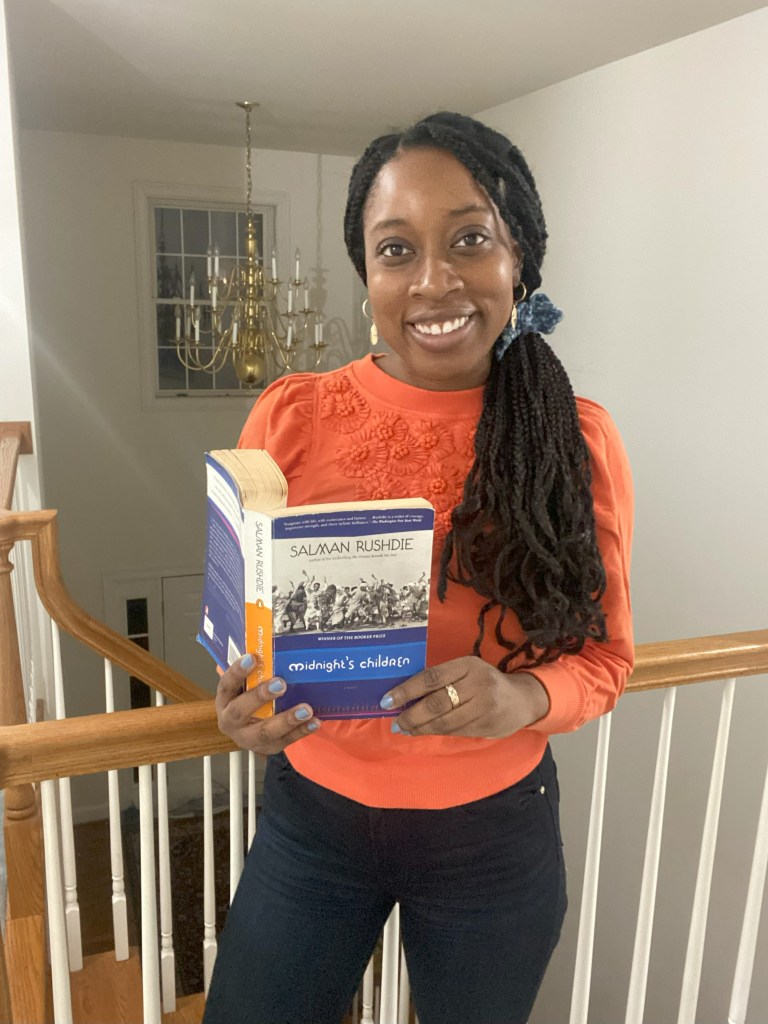
Midnight’s Children is a long-winded story of Indian independence told by a self-important narrator, Saleem Sinai, who isn’t born until almost 150 pages in. Saleem claims to have special abilities because he was born at midnight on the day India officially became a country. It is amusing to see how he relates monumental events to himself and his misshapen nose. Saleem writes “…life in Bombay was as multitudinously shapeless as ever…except that I had arrived; I was already beginning to take my place at the center of the universe; and by the time I had finished, I would give meaning to it all.” He blames himself and takes credit for things that occurred before his parents even met. He justifies it with the belief that, “Most of what matters in your life takes place in your absence.”
The writing of this is so excessively florid that it’s hard to follow not just at times but for most of the time. Usually I find books like this the author’s tedious way of proving they know a lot of words and can make a fancy sentence. However, though cumbersome for the reader, the garrulous voice fits so well with Saleem’s personality.
The story of Saleem growing up with a feral little sister, a capricious father and a mother who carries around secrets takes place in the backdrop of newly formed India. Saleem is the most unreliable of narrators. There are a lot of things you have to believe in order to believe him. First, that he has a prophetic nose. Second, that his memory is reliable. I found myself often asking, “is this true?” in the context of the story. And then, “is this true?” in the context of the real world. The second part requires more than just a deep knowledge of Indian history. It’s a rhetorical question that Rushdie forces on the reader. As Saleem recounts events and sometimes edits them he also tells the history of the Indo-Pakistani war. One of the most poignant points in the book is when Saleem is talking about the bombs that killed his family and how they were reported by All-India Radio versus what he experienced on the ground in Pakistan. He tries to examine the facts of the war with “an analytical, unprejudiced eye”.
“Important to concentrate on good hard facts. But which facts? Who attacked? Who defended? Were there parachutists or were there not? Did Islamic mirages and mysteries do battle with Hindu invaders, or was it all some kind of astonishing illusion? Did bombs fall? Were explosions true? Could even a death be said to be the case? On the night of September 22nd air-raids took place over every Pakistani city. Aircraft, real or fictional, dropped actual or mythical bombs. It is, accordingly, either a matter of fact or a figment of a diseased imagination that three bombs [eliminated my benighted family from the face of the earth].”
Admittedly I butchered and rearranged the many paged passage for ease of reading, but the message is the same. Suddenly, it seems silly to question a 12-year-old boy’s declaration that he can smell if a girl has a crush on him or if his mother is having an affair. There is no way to know the truth on these trivial matters if we can’t even agree on the truth of larger matters. Truth is subjective depending on whose facts we use. Even Saleem who bore witness to the death of relatives had to question what he was seeing before his eyes. In Saleem’s world news is controlled by a singular entity. In our world anyone can become a news source. In both extremes it is hard to point to an objective truth.
Overall, Midnight’s Children was tough to get through, even the second time around. Viscous might not be the most accurate way to describe a book but it’s the word that comes to mind with this one. However, I think this book was so clever at times that it’s worth wading through. My advice: read this book at the same time as a much lighter, more fluid read.


 Bisi the Bibliophile